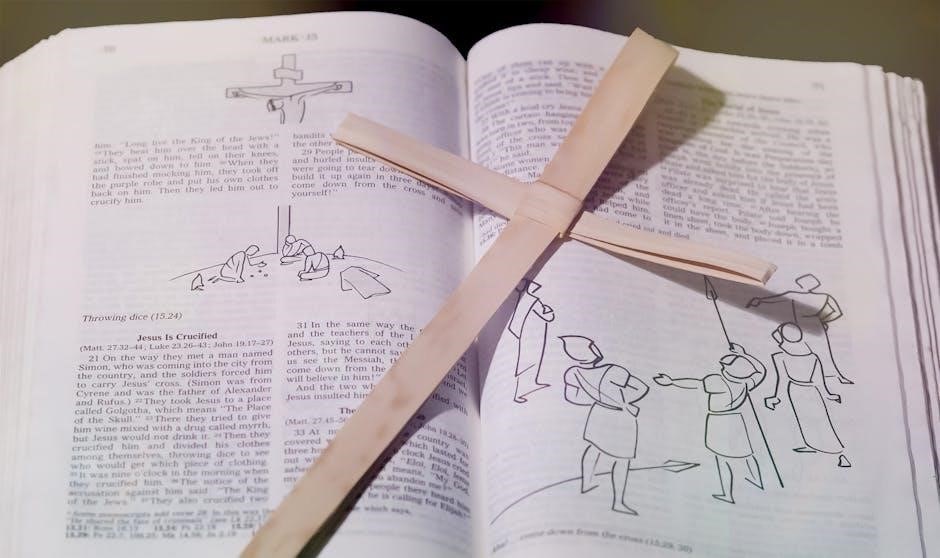
Exploring the Old Testament reveals layered gospel imagery, built over centuries, anticipating Jesus as the ultimate fulfillment of prophecy and divine promise.
The Concept of Typology in Biblical Interpretation
Typology, a crucial interpretive lens, understands Old Testament persons, events, and institutions as prefiguring realities in Christ. These “types” aren’t mere allegories, but divinely intended foreshadowings, revealing God’s consistent redemptive plan.
For example, the Passover lamb foreshadows Jesus as the Lamb of God (John 1:29), offering ultimate atonement. Similarly, the Tabernacle’s structure points to Jesus’ body as the dwelling place of God (John 2:21). Recognizing these typological connections unveils the interconnectedness of Scripture.
This approach, championed by early Church Fathers, demonstrates how God progressively revealed Himself throughout history, culminating in the person and work of Jesus Christ, offering a richer understanding of both Testaments.
The Importance of Understanding the Old Testament Context
Grasping the Old Testament’s historical and cultural context is paramount for correctly interpreting its prophetic significance. Ignoring this context risks misinterpreting types and shadows intended to point towards Jesus.
The Second Vatican Council emphasized a prayerful study of Scripture, yet a solely “scientific” approach, questioning historical legitimacy, can undermine faith. Understanding the development of Messianic expectation within Judaism is vital.
Without appreciating the original audience and their understanding, we risk imposing modern interpretations, obscuring God’s intended message. Contextual awareness unlocks the Old Testament’s rich foreshadowing of Christ, revealing a unified story of redemption.
The Pre-Incarnate Christ: Manifestations in the Old Testament
Examining Old Testament theophanies—like the Angel of the Lord—reveals glimpses of the divine Son before His incarnation, foreshadowing Jesus’ nature and role.
The Angel of the Lord (Malak Yahweh)
The frequent appearances of “the Angel of the Lord” (Malak Yahweh) throughout the Old Testament present a compelling case for pre-incarnate manifestations of Christ. This angelic figure isn’t simply a messenger; He is identified with God Himself, accepting worship and exercising divine authority. Instances in Genesis, such as the announcement to Hagar and Jacob’s wrestling match, demonstrate this unique status.
Scholars suggest these encounters weren’t with a created being, but with a visible representation of the divine Son, preparing humanity for the ultimate revelation in Jesus. This foreshadowing highlights the continuity between the Old and New Testaments, revealing God’s consistent plan of redemption unfolding throughout history. Studying these appearances deepens our understanding of Christ’s eternal nature.
The Divine Warrior
Throughout the Old Testament, God is consistently portrayed as a mighty warrior, battling against the forces of chaos and evil to deliver His people. From the Exodus account of defeating Pharaoh’s army to the victories in Canaan, these narratives reveal a God who actively intervenes in history. This depiction isn’t merely about national liberation; it foreshadows the ultimate victory won by Jesus Christ over sin and death.
Jesus, as the ultimate Divine Warrior, fulfills these Old Testament themes. His crucifixion and resurrection represent the decisive blow against Satan and the powers of darkness. Recognizing this warrior aspect of God in the Old Testament prepares us to appreciate the full scope of Jesus’ redemptive work and His future reign.
The Rock of Israel (1 Corinthians 10:4)
The Old Testament frequently refers to God as the “Rock of Israel,” a source of strength, stability, and refuge for His people. This imagery isn’t simply metaphorical; it points to a deeper spiritual reality. The Israelites relied on God for provision and protection during their wilderness wanderings, and He miraculously provided water from a rock (Exodus 17:6).
Paul, in 1 Corinthians 10:4, explicitly connects this “Rock” to Christ, stating they drank from the spiritual Rock that followed them. Jesus is the ultimate source of spiritual nourishment and life, just as the rock sustained Israel physically. He is the firm foundation upon which believers build their faith, offering unwavering support and security.
Sacrificial System and the Ultimate Sacrifice
Old Testament sacrifices foreshadowed Jesus, the Lamb of God, whose singular sacrifice provides complete and final atonement for sin, fulfilling ancient rituals.
The Passover Lamb and Jesus as the Lamb of God
The Passover lamb, central to Israel’s deliverance from Egypt, powerfully prefigures Jesus Christ. Just as the lamb’s blood spared the firstborn from death, Jesus’ sacrifice offers salvation from eternal condemnation. The Israelites’ freedom from slavery mirrors spiritual liberation through Christ.
This typology extends to the lamb’s perfection – without blemish – mirroring Jesus’ sinless nature. Both were offered as a substitutionary sacrifice; the lamb for the people, and Jesus for all humanity.
Furthermore, the timing of the Passover observance aligns with the crucifixion, occurring during the Passover season, solidifying the connection. Jesus is explicitly identified as the “Lamb of God” (John 1:29), directly linking Him to this ancient symbol of redemption and divine provision.
The Bronze Serpent and Jesus’ Lifting Up (John 3:14-15)
The story of the bronze serpent in Numbers 21 offers a striking parallel to Jesus’ crucifixion. When bitten by venomous snakes, the Israelites found healing by looking upon the elevated bronze serpent. This act of faith brought physical restoration.
Jesus draws a direct correlation in John 3:14-15, stating, “As Moses lifted up the serpent in the wilderness, so must the Son of Man be lifted up.” This “lifting up” refers to His crucifixion, emphasizing that looking to Him in faith provides spiritual healing and eternal life.
Both instances involve a remedy provided through elevation and faith. The bronze serpent offered temporary physical relief, while Jesus offers eternal salvation. The typology highlights the necessity of looking to Christ for deliverance from the venom of sin.
The Daily Sacrifices and Continuous Atonement
The Old Testament’s daily sacrificial system, meticulously detailed in the Law, perpetually addressed the issue of sin and its separation from God. These repeated offerings—burnt, sin, and peace offerings—were never fully sufficient to achieve lasting atonement.
They served as a constant reminder of humanity’s fallen state and the need for reconciliation. Each sacrifice foreshadowed the ultimate, once-for-all sacrifice of Jesus Christ on the cross. The continuous nature of the offerings pointed to an ongoing need for atonement.
Jesus, as the perfect Lamb of God, fulfilled the requirements of the Law, providing complete and final atonement for sin, rendering the daily sacrifices obsolete. His sacrifice offers a continuous, spiritual access to God.

Prophetic Predictions of the Messiah
Old Testament prophecies, concerning lineage, suffering, death, kingdom, and reign, remarkably converge on Jesus, demonstrating divine foresight and His messianic identity.
Messianic Prophecies Concerning Jesus’ Lineage (Genesis 3:15, Isaiah 11:1)
The seed of the woman in Genesis 3:15, promising victory over Satan, foreshadows Jesus’s lineage and redemptive role. Isaiah 11:1 speaks of a shoot from Jesse’s root, signifying a Davidic descendant—fulfilled in Jesus.
These prophecies weren’t merely about a kingly line, but a specific individual possessing divine authority. The anticipation of a Messiah from David’s line was deeply ingrained in Jewish expectation. Examining these texts reveals a deliberate unfolding of God’s plan.
Understanding the historical context and the covenant promises to David is crucial. Jesus’s genealogy, meticulously traced in Matthew and Luke, demonstrates this fulfillment, solidifying His claim as the promised Messiah and the rightful heir to David’s throne.
Prophecies Regarding Jesus’ Suffering and Death (Isaiah 53)
Isaiah 53 vividly portrays the suffering servant, unjustly bearing the sins of others – a striking parallel to Jesus’s crucifixion. The prophecy details His rejection, affliction, and ultimately, His sacrificial death for the transgressions of humanity.
Remarkably, the text anticipates the servant’s voluntary submission to suffering, and the subsequent justification of many through His sacrifice. This wasn’t a random tragedy, but a purposeful act within God’s redemptive plan.
The specificity of Isaiah 53 has long been recognized as a powerful messianic prophecy, pointing directly to Jesus’s atoning death on the cross, offering forgiveness and reconciliation with God.
Prophecies Concerning Jesus’ Kingdom and Reign (Psalm 2, Daniel 7)
Psalm 2 proclaims the Messiah’s divine sonship and His ultimate authority over the nations, foreshadowing Jesus’s reign as King of Kings. Daniel 7 unveils a vision of an eternal kingdom given to “one like a son of man,” widely interpreted as a messianic reference;
These prophecies depict a kingdom not of earthly power, but of righteousness and peace, established through the Messiah’s victory over opposition; They highlight a future where God’s will is done on earth as it is in heaven.
The Old Testament’s anticipation of Jesus’s kingdom offers hope and assurance of God’s ultimate triumph and the establishment of His everlasting reign.
Old Testament Characters as Types of Christ
Old Testament figures like Adam, Noah, and David serve as prophetic types, foreshadowing aspects of Jesus’ character, mission, and redemptive work.
Adam: The First Adam and the Last Adam (1 Corinthians 15:45)
The initial Adam, created righteous yet falling into sin, contrasts sharply with Jesus, the “Last Adam” (1 Corinthians 15:45). Adam’s disobedience brought death and condemnation to humanity, necessitating a redeemer. Jesus, however, perfectly obeyed God, reversing the effects of Adam’s fall.
This parallel isn’t merely symbolic; it’s a foundational theological concept. Adam represented all humanity in his rebellion, and Jesus represents all who believe in His sacrifice. Just as death came through Adam, life comes through Christ.
Understanding this typology illuminates the scope of redemption – a restoration of what was lost in Eden, achieved through the perfect life and atoning death of the Last Adam;
Noah: Salvation Through the Flood
The story of Noah’s Ark powerfully foreshadows salvation through Jesus Christ. A world corrupted by wickedness faced divine judgment – a global flood. Noah and his family, however, found grace in God’s eyes and were preserved through the ark, a symbol of refuge.
This parallels our salvation. Humanity is condemned by sin, facing God’s righteous judgment. Yet, through faith in Jesus, we enter a “safe haven” – a spiritual ark – shielded from eternal destruction.
The flood cleansed the earth, and Christ’s sacrifice cleanses us from sin. Both events represent a new beginning, a fresh start offered through God’s mercy and provision.
Abraham: Faith and the Promise of Redemption
Abraham’s unwavering faith, demonstrated through his willingness to sacrifice Isaac, is a profound type of God’s sacrifice of His Son, Jesus. God tested Abraham’s obedience, but ultimately provided a ram as a substitute – foreshadowing the ultimate substitute for sin.
The covenant God made with Abraham, promising countless descendants and blessing to all nations, finds its ultimate fulfillment in Jesus. Through Christ, the promise of redemption extends to all who believe, regardless of lineage.
Abraham’s faith is credited to him as righteousness, mirroring how we are justified by faith in Jesus, not by works. He is the father of all who believe.
Moses: The Lawgiver and Deliverer
Moses, as the lawgiver, delivered God’s law to Israel, revealing humanity’s inability to perfectly obey it. This inability points to the need for a greater deliverer – Jesus Christ, who fulfills the law on our behalf.
Like Moses, Jesus led his people out of bondage – not from physical slavery in Egypt, but from the slavery of sin and death. He is the ultimate deliverer, offering freedom through grace and forgiveness.
Furthermore, the Passover, instituted under Moses, foreshadows Jesus as the Lamb of God, whose sacrifice delivers us from eternal judgment. Moses’ role prefigures Christ’s redemptive work.
David: The Kingly Lineage and Shepherd King
David, Israel’s greatest king, establishes a royal lineage through which the Messiah would come, fulfilling ancient prophecies. God promised David an eternal throne, a promise ultimately fulfilled in Jesus Christ, the King of Kings.
As a shepherd, David exemplified care, protection, and leadership – qualities mirrored in Jesus, the Good Shepherd who lays down his life for his sheep. He guides, protects, and provides for his followers.
David’s psalms often foreshadow Jesus’ suffering, death, and resurrection, revealing a prophetic understanding of the Messiah’s role. His reign foreshadows Christ’s eternal kingdom.
Joseph: Betrayal, Suffering, and Exaltation
Joseph’s story strikingly parallels Jesus’ life: betrayed by his brothers, unjustly accused, and suffering greatly. Sold into slavery, he endured hardship and imprisonment, yet remained faithful to God.
Like Jesus, Joseph was innocent but suffered for the sins of others. His eventual exaltation to second-in-command in Egypt foreshadows Jesus’ ascension to the right hand of God, receiving ultimate authority.
Joseph’s ability to forgive his brothers mirrors Christ’s forgiveness of those who crucified him. Both stories demonstrate God’s power to turn suffering into salvation and demonstrate redemptive grace.
Symbolic Representations of Christ in the Old Testament
Old Testament symbols—Tabernacle, manna, and water from the rock—profoundly foreshadow Jesus as the ultimate provision, dwelling place, and source of life.
The Tabernacle and the Temple as Foreshadowings of Jesus’ Body
The intricate design of the Tabernacle and later, the Temple, served as earthly representations of God’s dwelling among His people, powerfully foreshadowing Jesus Christ. Just as the Tabernacle housed the presence of God, Jesus, being fully God and fully man, became the ultimate dwelling place of the Divine.
Each element—the Holy of Holies, the veil, the altar—pointed towards aspects of Jesus’ person and work. The veil, torn at His death, symbolized open access to God through Christ’s sacrifice. The Temple’s structure, meticulously planned, mirrored the perfection and completeness found in Jesus, the true and lasting Temple, offering a pathway to reconciliation with God.
Manna in the Wilderness and the Bread of Life (John 6)
The provision of manna during the Israelites’ wilderness wanderings wasn’t merely sustenance; it was a tangible symbol of God’s faithfulness and a prophetic foreshadowing of Jesus Christ. Just as manna sustained physical life, Jesus declares Himself the “Bread of Life” (John 6), offering spiritual nourishment and eternal life to all who believe.
This connection is explicitly drawn by Jesus Himself, contrasting the temporary nature of manna with the enduring life He offers. The Israelites had to gather manna daily, but faith in Jesus provides a lasting, abundant life. He is the true bread from heaven, satisfying a deeper hunger than physical needs, fulfilling a divine promise of redemption.
The Water from the Rock and the Living Water (John 4)
The miraculous provision of water from the rock, as recounted in Exodus 17, powerfully prefigures Jesus’ offer of “living water” to the Samaritan woman at the well (John 4). The rock, struck by Moses, provided temporary physical relief from thirst, mirroring the Israelites’ need for sustenance in the wilderness.
However, Jesus presents a water that quenches a far deeper thirst – a spiritual longing that only He can satisfy. This “living water” promises eternal life, a continuous source of refreshment and fulfillment. It’s a divine gift, surpassing any earthly provision, and points to Jesus as the ultimate source of life and salvation.

The Role of the Old Testament Law in Pointing to Christ
The Old Testament Law, though seemingly restrictive, served as a pedagogue, guiding humanity toward Christ, whose arrival fulfills and transcends its requirements.
The Fulfillment of the Law (Matthew 5:17)
Jesus’ declaration in Matthew 5:17, “Think not that I am come to abolish the law, but to fulfill it,” is pivotal. He didn’t discard the Law’s moral weight, but perfectly embodied its intent. The Old Testament Law, with its intricate system of commands and sacrifices, foreshadowed Christ’s complete obedience and ultimate sacrifice.
This fulfillment isn’t merely a historical event; it’s a theological reality. Jesus lived a sinless life, satisfying the Law’s demands on behalf of humanity. His death on the cross provided the ultimate atonement, rendering further sacrificial offerings unnecessary. Understanding this fulfillment unlocks a deeper appreciation for the interconnectedness of the Old and New Testaments, revealing a unified narrative of redemption centered on Jesus Christ.
The Moral Law and its Reflection of God’s Character
The Old Testament’s moral law, embodied in the Ten Commandments, isn’t arbitrary; it’s a reflection of God’s own holy character. These commands reveal God’s righteousness, justice, and love, providing a standard for human conduct. While humanity consistently failed to uphold this standard, the Law served as a tutor, pointing to our need for a savior.
Jesus, as God incarnate, perfectly exemplified the moral law, demonstrating its true intent and fulfilling its demands. He didn’t lower the standard but raised it, challenging inward attitudes alongside outward actions. Recognizing the Law’s divine origin and Jesus’ fulfillment illuminates God’s unwavering commitment to holiness and His boundless grace towards humanity.

Historical and Theological Considerations
Debates surrounding the Old Testament’s historical legitimacy and messianic expectation impact interpretations, with the Second Vatican Council aiming for renewed scriptural study.
The Development of Messianic Expectation in Judaism
Throughout centuries, Jewish expectation of a Messiah evolved, shaped by prophetic texts and historical circumstances. Initially, a Davidic king restoring Israel’s glory was anticipated, yet interpretations broadened. Suffering Messiah concepts emerged, particularly influenced by Isaiah’s servant songs, portraying a figure enduring hardship for collective redemption.
This expectation wasn’t monolithic; diverse schools of thought coexisted, envisioning varying roles for the Messiah – a priestly figure, a prophetic leader, or a military conqueror. The intertestamental period witnessed heightened messianic fervor, fueled by oppression and a longing for liberation. These evolving hopes provided the backdrop against which Jesus’ ministry unfolded, and understanding this context is crucial for interpreting New Testament claims about his messianic identity.
The Second Vatican Council and Biblical Interpretation
The Second Vatican Council, through Dei Verbum, encouraged a renewed, prayerful engagement with Scripture, aiming to unlock its spiritual richness. This initiative sought to move beyond purely historical-critical methods, fostering a holistic approach integrating faith and reason. However, the Council’s vision faced challenges as the “scientific approach” to the Bible gained prominence.
Increased scrutiny of the Old Testament’s historical legitimacy arose, questioning the events’ factual basis. “Quests for the historical Jesus” often separated the man from the Christ of faith, potentially undermining believers’ convictions. While intending clarity, these approaches sometimes inadvertently diminished faith, highlighting a tension between scholarly inquiry and traditional belief.
Challenges to Historical Legitimacy of the Old Testament
The historical accuracy of the Old Testament narratives has faced increasing scrutiny from scholars employing modern critical methods. Questions regarding authorship, dating, and the presence of mythical or legendary elements have been raised, challenging traditional understandings of its events. This skepticism stems from archaeological findings and comparative studies with other ancient Near Eastern texts.
These challenges often lead to debates about the Old Testament’s reliability as a source for historical reconstruction. Some scholars propose viewing the text primarily as theological literature, conveying spiritual truths rather than literal historical accounts, impacting interpretations of foreshadowing.
Resources for Further Study: “Seeing Jesus in the Old Testament” PDFs
Numerous PDFs explore this topic, including the Coptic Sahidic Old Testament project and works by authors like Adam S. Miller and Rosalynde Welch.
Online Availability of Relevant PDFs
Accessing resources digitally offers convenience for studying connections between the Old and New Testaments. The Göttingen Academy’s collaborative project, focused on the Coptic Sahidic Old Testament, provides research materials potentially available online. While direct links to comprehensive “Seeing Jesus in the Old Testament” PDFs may require focused searching, academic databases and theological libraries often host relevant scholarly articles. Furthermore, exploring websites dedicated to biblical studies and Christian apologetics can yield valuable downloadable content.
Consider searching for publications by authors mentioned in reviews, such as Chad Nielsen, Adam S. Miller, and Rosalynde F. Welch, to locate their work in PDF format. Remember to verify the source’s credibility before relying on any downloaded material.
Recommended Authors and Books on the Topic
For deeper exploration, consider works by Adam S. Miller and Rosalynde F. Welch, authors of “Seven Songs: Signs of Christ in the Old Testament,” praised for its thematic approach. Chad Nielsen’s contributions also offer valuable insights into Old Testament typology. Examining resources that address the historical Jesus and Messianic expectations within Judaism is crucial.
Additionally, exploring the writings of scholars who engage with the Dei Verbum document from the Second Vatican Council can provide context for contemporary biblical interpretation. Investigating works that address challenges to the historical legitimacy of the Old Testament will offer a balanced perspective.
The Old and New Testaments intertwine, revealing a cohesive narrative centered on Jesus Christ, the ultimate fulfillment of God’s redemptive plan for humanity.
The Interconnectedness of the Old and New Testaments
Understanding the Old Testament isn’t merely historical context; it’s recognizing foreshadowing deliberately woven into the fabric of scripture. The New Testament doesn’t negate the Old, but fulfills it, revealing Jesus as the culmination of centuries of prophetic anticipation.
Patterns emerge when examining Old Testament rituals, characters, and prophecies through a Christocentric lens. The sacrificial system, for example, points towards Jesus’ ultimate sacrifice. Figures like David, with his kingly lineage, prefigure the Messiah’s reign.
This interconnectedness demonstrates a unified story of redemption, where God’s plan unfolds progressively, culminating in Jesus Christ. Studying both testaments together unveils a richer, more profound understanding of God’s character and His unwavering love for humanity.
The Centrality of Jesus Christ in Biblical History
Jesus isn’t a later addition to the biblical narrative; He is the pivotal figure towards which all of history converges. The Old Testament, viewed through a Christocentric perspective, reveals a consistent trajectory pointing to His arrival.
Even amidst challenges to the historical legitimacy of the Old Testament, the enduring faith recognizes Jesus as the fulfillment of Messianic prophecies. The Second Vatican Council emphasized prayerful study, yet scientific approaches sometimes undermined belief.
Ultimately, recognizing Jesus’ centrality transforms our understanding of scripture, revealing a cohesive story of God’s redemptive plan, anchored in His Son, and offering hope to all humanity.